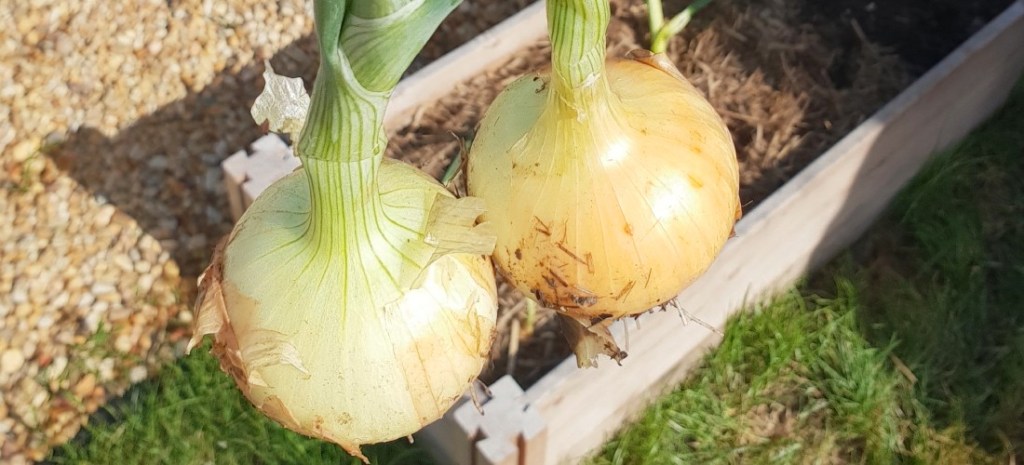
Onions are certainly valuable for adding flavour to other foods. They’re a kitchen staple and are very versatile. Plus, they last for a good time – whether they’ve been harvested from your garden or purchased from the market.
All onion varieties are easy to grow, most gardeners will tell you.
But I made one crucial mistake when growing brown onions at home: harvesting them too early. Still, I learnt plenty along the way.
Sunny location
Brown onions thrive in the sun, so I planted mine in a warm spot which was getting full-sun all hours of the day. In the shade, they probably wouldn’t have formed bulbs at all.
In fact, I had one that just didn’t want to grow into an onion. Instead, I was left with a long, green top and a thin, small bulb.
I’m still unsure whether this particular plant wasn’t getting enough sunshine because the remaining seven formed bulbs – although not all to full-size. This could’ve been because I harvested too early (see ‘Harvest time’).
Acidic soil
Green thumbs say brown onions grow best in slightly acidic soil. I didn’t test my soil and I likely suffered because of it.
A pH of around 6.5 is ideal for optimum bulb development. Use a home soil testing kit to determine the pH of your garden soil.
To increase your soil’s pH, sprinkle powdered limestone on top of the soil and work it in well or mix 1 tablespoon of baking soda into a few litres of water and saturate the soil.
Add 2 inches of compost to soil to lower the pH. Use either of these options, if needed, two weeks before planting.
Planting time
Onions can be sowed any time between February and September in cool climates – which includes most of Victoria and Tasmania – according to The Seed Collection.
I used a marker to make a small hole a couple of cms deep, and then repeated the process to create a 2×4 grid, with each of the eight onions maybe 10cm apart. I covered them lightly with soil and watered them in.
After care
I was constantly watering the onions while they were trying to establish. They’re shallow-rooted plants, so once they were about 10cm-15cm tall, I added lots of Sugar Cane mulch to help retain the moisture. It did a good job – especially on warmer days.
Harvest time
Finally, here’s where it all fell over: I harvested them before the green tops had died off and fallen over.
This resulted in onions of various sizes. I had one or two good-sized ones but the rest were tiny. When a recipe called for one onion, we were using two or three.
Onions need time and picking them early meant I missed out on a plentiful harvest.
 Matt's Plants & Co - Australia
Leave a comment